You can also find out who the registered keeper is if a car has been illegally parked on private property by contacting the DVLA (V888 form). You can find out who owns a number plate if you work for a company that issues parking fines or provides penalty notifications for trespassing.
If you’re wondering how old a used car might be, we tried to answer all of your questions about UK number plates, from the history of the plates to how to quickly monitor the vehicle age from the number plate history check, vehicle check and other methods.
The research is necessary because the car’s value is frequently influenced by its year of production and how long it runs.
UK number plate check-decoded
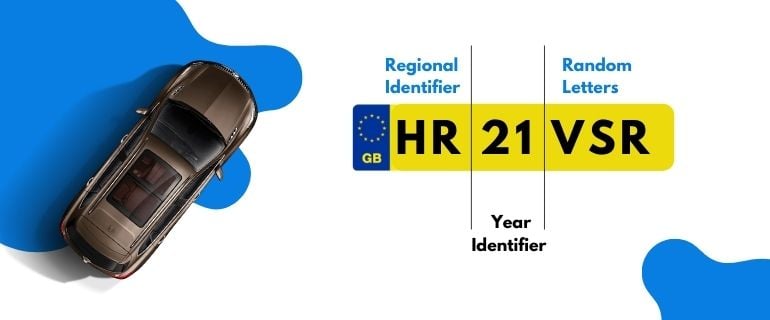
In the UK, new registrations changed twice a year after September 2001. The current number plate consists of three parts:
- Memory tag: First two letters shows the place where it was registered. The first letter represents the region, followed by the DVLA local office.
- Age identifier: The two numbers in the middle show the age of the vehicle. We explained these new-style registrations of identifying the age below.
- Random letters: Last three letters are random and are offered to the car as a unique identity.
What year is my car by number plate ?
Did you know the history of number plates? Are you searching for new number plates to buy this year? Here is brief research about how number plates are identified as age identifiers & their evolution, and when you choose to buy the car, it ensures you decode its age.
Suffix and prefix registrations:
In 1963, the suffix letter system was an age identifier. The system is active from 1963 to 1982. It made where the age of the vehicle identified through the letter starts from A to Y (except I, O, Q, U, and Z) series. The suffix systems ended; hence, after 1982, the system introduced the prefix number plate registrations.
The prefix number plate systems were issued from 1983 to 2001. It also follows the same pattern where vehicle age identified through the letter starts from A to Y excluding I, O, Q, U, Z. This system also ended after August 2001.
New style registrations:
New style registrations are also referred to as Millennium registrations, adopted in 2001. As previously determined by the new-style number plate, the number mentioned in the seven characters in number plates can be found.
Unlike suffix and prefix systems, there are two-millennium releases each year. The dating began with 51 second-half, specifically September 2001. It continued with 02- first half of 2002 proceeds from there.
DVLA Vehicle Check
Check if the vehicle V5C logbook is original and if it has a DVLA watermark.
The location where your vehicle was first registered with the DVLA check, it is easily accessible. As everyone is aware, the registration date is printed on the V5C or car registration paperwork. Alternatively, you can check vehicle number plate history for free and receive a complete report on the vehicle’s history.
What does the number plate check offer?
As previously stated, the DVLA helps to disclose the vehicle information about the age, make, model, fuel type, and basic information. However, it is difficult to say if the previous owner changed or altered the number plate. And hence, the vehicle check report gives a hand to tell you the current VRM and how many number plate changes occurred before.
It comes under our basic vehicle check reports cost you £1.99; else, you need a complete vehicle check history report. Feel free to ask about the reports with our support mail, and we will help you resolve queries.
Answering your questions
Can I perform multiple checks using the gov.uk number plate check?
Yes, you can use the gov.uk number plate check for multiple vehicles. There is no limit to the number of times you can use the service.
Are there any privacy concerns when using the gov.uk number plate check?
The gov.uk number plate check does not reveal personal information about the vehicle owner or any sensitive data. It only provides general vehicle details and status information.
Can I use the gov.uk number plate check for any vehicle?
The gov.uk number plate check is designed for vehicles registered in the UK. It includes cars, motorcycles, vans, trucks, and other types of road vehicles. However, it may not provide information for vehicles registered outside of the UK.
Related Blogs:
Cloned Number Plates In The UK: Risks, Impact, and Countermeasures
How To Check Number Of Previous Owners Or Keepers History?
How To Find Number Of Previous Owners Of A Car In The UK